Accurate road network information plays a vital role in transportation planning, urban development, and navigation analysis. With GIS Data by MAPOG, users can easily Download Secondary Road Data in multiple GIS formats such as Shapefile, KML, GeoJSON, and MID. The platform is designed to provide structured geographic datasets that can be seamlessly integrated into various GIS applications. Secondary roads typically connect local streets with primary highways and play a crucial role in regional connectivity, traffic flow, and accessibility.
How to Download Secondary Road Data
MAPOG simplifies the process of accessing GIS datasets through a well-structured interface. The platform offers access to hundreds of data layers and supports more than fifteen GIS file formats including SHP, KML, CSV, GeoJSON, SQL, DXF, MIF, GPX, and TOPOJSON. This makes it easier for GIS professionals, planners, and researchers to work with compatible data formats across different software environments.
Download Secondary Road Data of Any Region
Note:
- All datasets are available in GCS Datum EPSG:4326 WGS84 Coordinate Reference System.
- Users must log in to the platform before downloading the desired datasets.
Step-by-Step Guide to Download Secondary Road Data
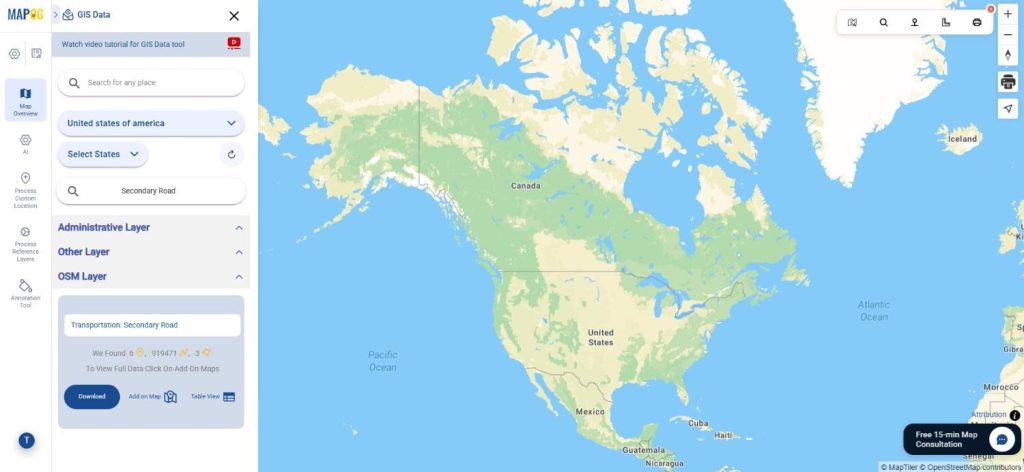
Step 1: Search for Secondary Road Data
Begin by selecting the required dataset within the GIS Data by MAPOG interface. Use the search layer option and type Secondary Road Data to locate the dataset. The platform will display relevant layers along with their attributes and geometry type.
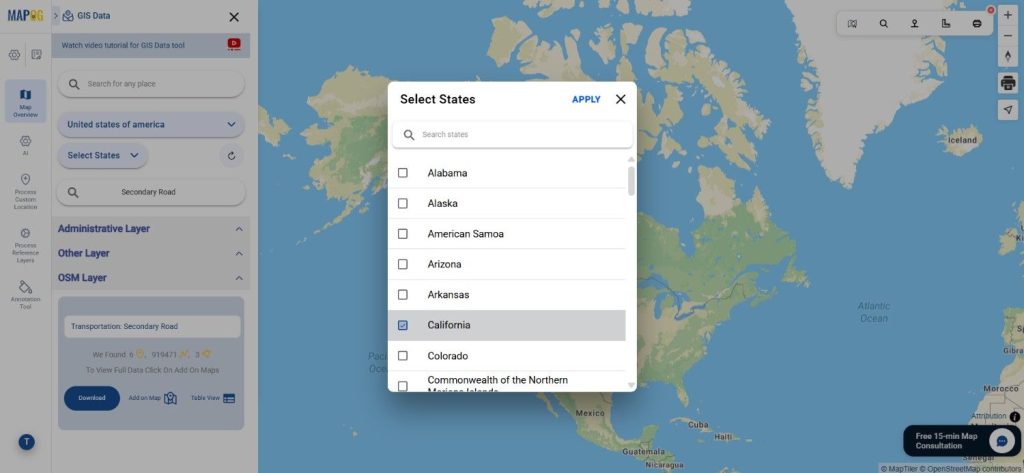
Step 2: Apply Data Filters
To refine the dataset further, use the Filter Data option. This feature allows users to narrow results by state or district, enabling a deeper level of data discovery and ensuring more precise geographic information for analysis.
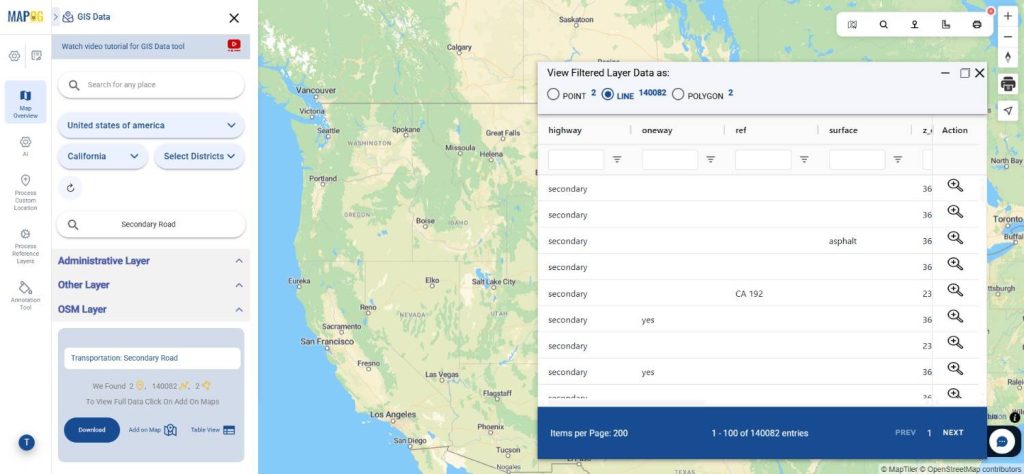
Step 3: Visualize Using “Add on Map”
Before downloading, users can preview the dataset by selecting Add on Map. This feature overlays the selected road layer on the interactive GIS analysis interface, allowing users to study road connectivity, patterns, and spatial relationships more effectively.
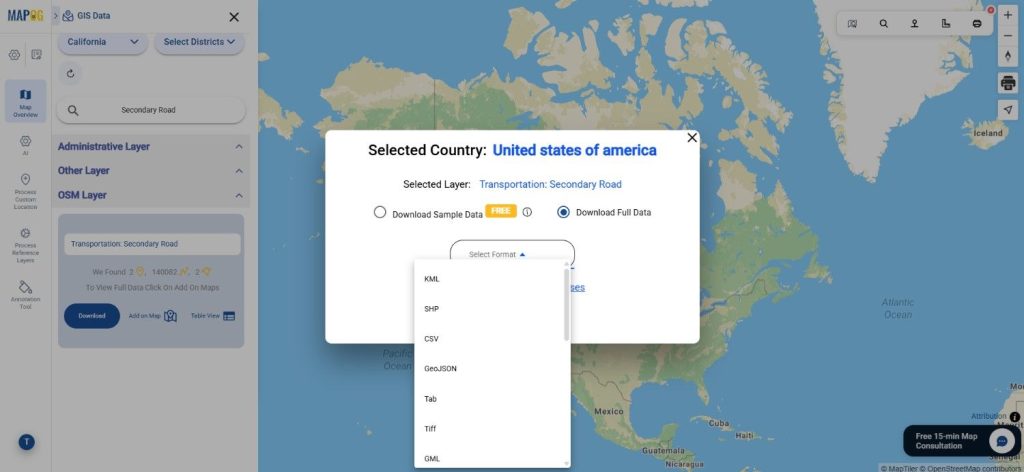
Step 4: Download Secondary Road Data
After verifying the dataset, click on the Download Data option. Users can choose between a sample dataset or the complete version. Select the preferred format such as Shapefile, KML, MID, or any of the other supported GIS formats, accept the terms, and proceed with the download.
Conclusion
Accessing accurate road network information is essential for mapping, infrastructure planning, and geographic research. With GIS Data by MAPOG, users can efficiently Download Secondary Road Data in multiple GIS-compatible formats and integrate it directly into their spatial analysis workflows. The platform’s search tools, filtering options, and visualization features make it a reliable solution for working with comprehensive road datasets in a streamlined and efficient manner.
With MAPOG’s versatile toolkit, you can effortlessly upload vectors and upload Excel or CSV data, incorporate existing layers, perform polygon splitting, use the converter for various formats, calculate isochrones, and utilize the Export Tool.
For any questions or further assistance, feel free to reach out to us at support@mapog.com. We’re here to help you make the most of your GIS data.
Download Shapefile for the following:
- World Countries Shapefile
- Australia
- Argentina
- Austria
- Belgium
- Brazil
- Canada
- Denmark
- Fiji
- Finland
- Germany
- Greece
- India
- Indonesia
- Ireland
- Italy
- Japan
- Kenya
- Lebanon
- Madagascar
- Malaysia
- Mexico
- Mongolia
- Netherlands
- New Zealand
- Nigeria
- Papua New Guinea
- Philippines
- Poland
- Russia
- Singapore
- South Africa
- South Korea
- Spain
- Switzerland
- Tunisia
- United Kingdom Shapefile
- United States of America
- Vietnam
- Croatia
- Chile
- Norway
- Maldives
- Bhutan
- Colombia
- Libya
- Comoros
- Hungary
- Laos
- Estonia
- Iraq
- Portugal
- Azerbaijan
- Macedonia
- Romania
- Peru
- Marshall Islands
- Slovenia
- Nauru
- Guatemala
- El Salvador
- Afghanistan
- Cyprus
- Syria
- Slovakia
- Luxembourg
- Jordan
- Armenia
- Haiti And Dominican Republic
- Malta
- Djibouti
- East Timor
- Micronesia
- Morocco
- Liberia
- Kosovo
- Isle Of Man
- Paraguay
- Tokelau
- Palau
- Ile De Clipperton
- Mauritius
- Equatorial Guinea
- Tonga
- Myanmar
- Thailand
- New Caledonia
- Niger
- Nicaragua
- Pakistan
- Nepal
- Seychelles
- Democratic Republic of the Congo
- China
- Kenya
- Kyrgyzstan
- Bosnia Herzegovina
- Burkina Faso
- Canary Island
- Togo
- Israel And Palestine
- Algeria
- Suriname
- Angola
- Cape Verde
- Liechtenstein
- Taiwan
- Turkmenistan
- Tuvalu
- Ivory Coast
- Moldova
- Somalia
- Belize
- Swaziland
- Solomon Islands
- North Korea
- Sao Tome And Principe
- Guyana
- Serbia
- Senegal And Gambia
- Faroe Islands
- Guernsey Jersey
- Monaco
- Tajikistan
- Pitcairn
Disclaimer : The GIS data provided for download in this article was initially sourced from OpenStreetMap (OSM) and further modified to enhance its usability. Please note that the original data is licensed under the Open Database License (ODbL) by the OpenStreetMap contributors. While modifications have been made to improve the data, any use, redistribution, or modification of this data must comply with the ODbL license terms. For more information on the ODbL, please visit OpenStreetMap’s License Page.
Here are some blogs you might be interested in:
- Download Airport data in Shapefile, KML , MIf +15 GIS format – Filter and download
- Download Bank Data in Shapefile, KML, GeoJSON, and More – Filter and Download
- Download Railway data in Shapefile, KML, GeojSON +15 GIS format
- Download Farmland Data in Shapefile, KML, GeoJSON, and More – Filter and Download
- Download Pharmacy Data in Shapefile, KML, GeoJSON, and More – Filter and Download
- Download ATM Data in Shapefile, KML, MID +15 GIS Formats Using GIS Data by MAPOG
- Download Road Data in Shapefile, KML, GeoJSON, and 15+ GIS Form
Leave a Reply